Day Three at the 36° FIPMed
Por: Võ Thị Như Mai
An Evening with Paul Muldoon, Poetry Became a Conversation Across Cultures
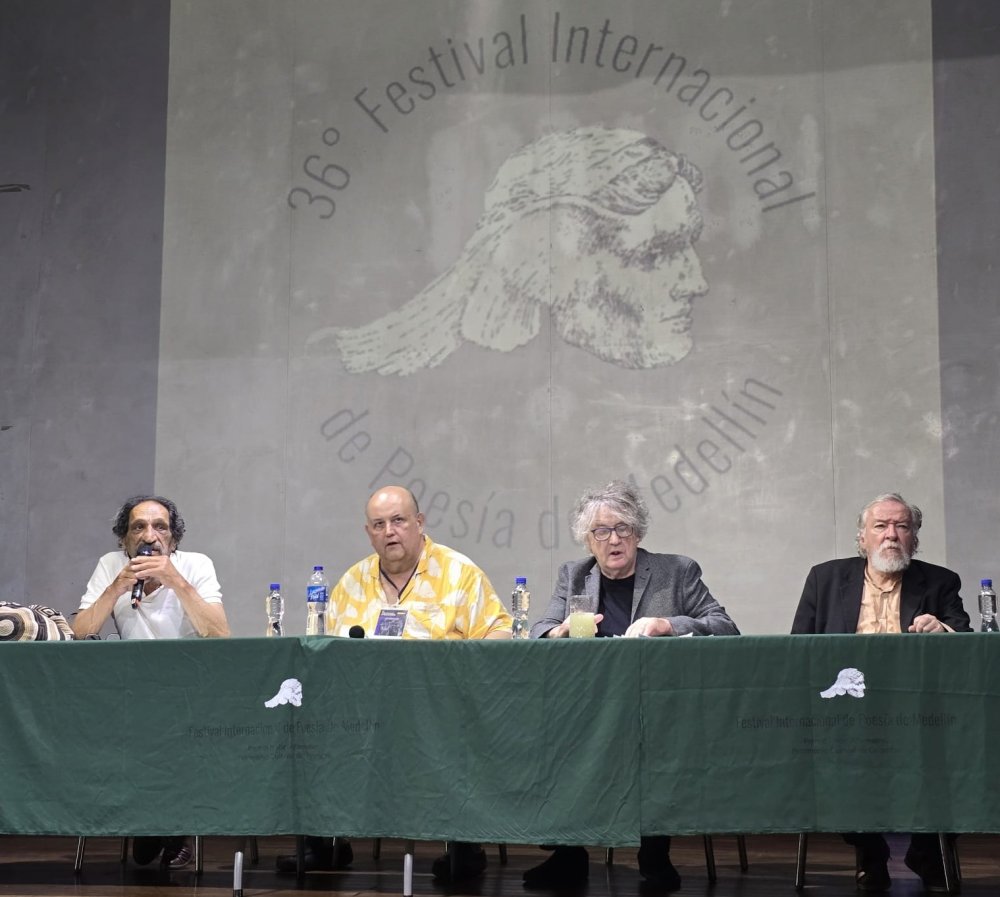
The third day of the 36th Medellín International Poetry Festival concluded with one of its most intellectually rewarding events: an evening of poetry reading and conversation with renowned Northern Irish poet Paul Muldoon. Held at the historic Teatro Ateneo Porfirio Barba Jacob in the heart of Medellín, the session brought together poets, readers and literature lovers for a thoughtful exploration of poetry, memory, identity and language.
The dialogue was led by Colombian poets Gabriel Jaime Franco and Fernando Rendón, founder and director of the Medellín International Poetry Festival. Rather than a formal interview, the evening unfolded as an open literary conversation, inviting both the speakers and the audience to reflect on the deeper purpose of poetry in today’s world.
Paul Muldoon, born in Portadown, Northern Ireland, in 1951, is regarded as one of the most influential English-language poets of our time. The author of more than thirty collections of poetry, he has received many of the world’s highest literary honours, including the Pulitzer Prize for Poetry and the T. S. Eliot Prize. His work extends beyond poetry into translation, songwriting, literary criticism and teaching. For many years he served as Professor of the Humanities and Founding Chair of the Lewis Center for the Arts at Princeton University, helping shape a new generation of writers while continuing to produce an extraordinary body of creative work.
Fernando Rendón opened the evening by placing Muldoon’s poetry within the long and rich tradition of Irish literature. His introduction became a fascinating journey through Ireland’s cultural memory.
He spoke about the ancient Gaelic tradition, the medieval poets, Celtic mythology and the enduring power of oral storytelling. These traditions, he explained, continue to shape modern Irish poetry, not as relics of the past but as living voices that help people understand who they are and where they come from.
One of the most memorable ideas of the evening came when Fernando reflected on humanity’s need to return to its origins. Nature, landscapes and ancient stories, he suggested, preserve a wisdom that modern society often forgets. He drew a beautiful connection between Irish mythology and the oral traditions of Indigenous peoples in Colombia and throughout the Americas, reminding the audience that every culture carries its own sacred stories and that poetry remains one of the most powerful ways of preserving them.
This thoughtful introduction created the perfect atmosphere for the conversation that followed.
Gabriel Jaime Franco guided the dialogue with questions that moved beyond literary technique. Instead of asking only about books and awards, he invited Muldoon to reflect on his personal relationship with poetry. How does poetry accompany everyday life? Does writing emerge from discipline or inspiration? How does a private memory become a poem capable of speaking to thousands of readers across cultures?
These questions revealed the true spirit of the festival: poetry is not simply something to be admired from a distance but a living practice that grows out of daily experience, curiosity and careful attention to the world.
Members of the audience then joined the conversation with thoughtful questions of their own. Several were interested in the relationship between personal history and collective memory in Muldoon’s work. Others asked about his creative process and the influences that shaped his poetic voice. The discussion reflected the remarkable diversity of the audience, bringing together people from different countries who shared the same desire to understand poetry more deeply.
An essential part of the evening’s success was the outstanding work of interpreter George Angel. Moving effortlessly between English and Spanish, he ensured that every poem, question and response remained clear, accurate and engaging for the audience. Literary conversations are among the most challenging events to interpret, requiring not only linguistic precision but also sensitivity to tone, rhythm and cultural nuance. George handled each transition with remarkable professionalism, allowing the dialogue to flow naturally without interrupting its pace or intimacy. His calm presence and exceptional skill made it possible for everyone, regardless of language, to fully participate in the conversation and appreciate the richness of the exchange.
Another memorable element of the evening was the Spanish reading of Paul Muldoon’s poems by Colombian poet John Viana. His expressive and carefully measured delivery allowed the audience to experience the poems in a new way, preserving both their emotional depth and lyrical beauty. Reading poetry in translation is never simply about changing one language into another; it is about carrying across rhythm, imagery and feeling. John Viana accomplished this with remarkable sensitivity, helping Spanish-speaking listeners connect deeply with Muldoon’s work and reinforcing the festival’s commitment to building bridges between languages and cultures through poetry.
Listening to the conversation, it became clear why Paul Muldoon occupies such an important place in contemporary literature. His poetry combines extraordinary technical skill with intellectual playfulness. His poems are rich with unexpected images, historical references, humour and intricate wordplay, yet beneath this complexity lie universal concerns: family, memory, identity, conflict, love and the fragile relationship between language and truth.
For readers unfamiliar with Irish history, the discussion also offered valuable insight into Northern Ireland’s cultural landscape. Muldoon’s work recount historical events and transforms history into imaginative language, inviting readers to discover new meanings rather than offering straightforward answers.
One of the greatest strengths of the evening was its atmosphere of genuine dialogue. Although Paul Muldoon is an internationally celebrated poet, the conversation remained warm, generous and accessible. There was no distance between the stage and the audience. Questions were welcomed with sincerity, and the discussion became a shared exploration of literature rather than a formal academic lecture.
The poetry reading itself reminded everyone that poems are meant not only to be read but also to be heard. As Muldoon read his work aloud, the rhythm, musicality and subtle humour of his language came alive in ways that cannot always be experienced on the printed page. His voice carried both precision and warmth, inviting listeners to slow down and savour every line.
As the evening drew to a close, Fernando Rendón thanked both the guest poet and the audience for participating in what he described as one of the festival’s most intimate literary encounters. His closing remarks captured the essence of the Medellín International Poetry Festival: poetry is not merely an artistic expression but a meeting place where cultures listen to one another, histories are shared and new friendships begin.
Leaving Teatro Ateneo Porfirio Barba Jacob, I found myself reflecting not only on Paul Muldoon’s remarkable career but also on the extraordinary generosity of the festival itself. In Medellín, poetry does not belong exclusively to poets. It belongs to everyone willing to listen, to ask questions and to enter into conversation.
This evening demonstrated that poetry remains one of humanity’s most powerful bridges. Across languages, continents and histories, it continues to remind us that although our stories begin in different places, they often lead us to the same search—for memory, for meaning and for our shared human voice.